
Quick Overview:
Good drainage does far more than move water away from a building. It protects foundations, keeps soil stable, reduces concrete damage, and lowers repair costs for years to come. Learn why proper grading, drainage planning, and site preparation are essential for lasting property performance.
Drainage design is one of the most overlooked parts of site preparation, yet it affects almost every part of a property’s long-term performance. Many owners focus on the building itself, the foundation, or the finished appearance of the site. Water management often becomes an afterthought. Unfortunately, that’s where expensive problems begin.
Rainwater always finds a path. If the site is not graded correctly or drainage systems are poorly planned, water can collect around foundations, wash away supporting soils, damage landscaping, and shorten the life of concrete surfaces. These issues rarely appear overnight. Instead, they develop slowly, becoming costly repairs years after construction is complete.
Investing in drainage during construction is far less expensive than repairing settlement, erosion, cracked concrete, or moisture damage later. A well-designed drainage system protects the entire property for decades.
Why Drainage Design Matters Before Construction Begins
Drainage design is the process of planning how surface water and groundwater move across and away from a property. The goal is simple. Prevent water from collecting where it should not while directing it safely away from structures.
Every property has its own natural drainage pattern. Rain follows the land’s slopes, low spots, and soil conditions. Without proper planning, construction can change these natural flow patterns, creating new drainage problems that did not exist before.
This is why drainage planning should always be completed during site preparation. Before foundations are placed or concrete is poured, contractors should understand how water enters, leaves, and travels through the property.
Grading, excavation, and drainage all work together.
- Excavation creates the building pad and site elevations.
- Grading shapes the finished slopes.
- Drainage systems collect and redirect water.
- Soil preparation supports everything above it.
When these elements are coordinated from the beginning, the finished property performs much better over its lifetime.
The Long-Term Problems Caused by Poor Drainage
Foundation Movement and Settlement
Foundations rely on stable supporting soil. When excessive water enters that soil, its strength changes.
Water can wash away fine soil particles beneath foundations, creating hidden voids. In some areas, moisture causes expansive soils to swell, then shrink during dry weather. These repeated cycles place stress on the foundation.
Over time, uneven settlement may develop, causing:
- Foundation movement
- Interior wall cracks
- Uneven floors
- Sticking windows and doors
- Structural repairs
Most settlement problems begin with uncontrolled moisture.
Standing Water Around Structures
Water should never remain next to a building after rainfall.
Standing water increases hydrostatic pressure against foundation walls. As pressure builds, moisture looks for the easiest path into the structure.
This can lead to:
- Wet crawl spaces
- Basement leaks where applicable
- Moisture intrusion
- Mold growth
- Interior damage
Keeping water moving away from the structure greatly reduces these risks.
Soil Erosion Across the Property
Poor drainage slowly reshapes a property.
Moving water carries away valuable topsoil, leaving exposed subgrade behind. Landscaping suffers first, but erosion eventually affects larger site features.
Common results include:
- Washed-out mulch and planting beds
- Damaged slopes
- Gullies forming after storms
- Retaining area instability
- Loss of usable landscape
Once erosion begins, repairs often become ongoing maintenance expenses.
Pavement and Concrete Damage
Concrete performs best when the supporting base remains stable.
Excessive moisture weakens the soil beneath driveways, sidewalks, patios, and parking areas. As the base settles, the concrete begins to crack or shift.
Repeated water exposure can also cause:
- Surface spalling
- Concrete scaling
- Joint deterioration
- Sidewalk settlement
- Parking lot failure
Good drainage protects both the concrete and the soils supporting it.
How Proper Drainage Protects Property Investments
Preserves Foundation Stability
The biggest benefit of good drainage is consistency.
Stable moisture levels help supporting soils maintain their strength throughout the year. Instead of expanding during wet seasons and shrinking during dry periods, soils remain much more predictable.
That consistency protects the foundation from unnecessary movement.
Reduces Maintenance Costs
Small drainage improvements during construction often eliminate large repair bills later.
Property owners typically experience:
- Fewer foundation repairs
- Less landscape replacement
- Reduced erosion control work
- Longer pavement life
- Lower maintenance costs
Preventive work almost always costs less than corrective work.
Extends the Life of Concrete and Masonry
Concrete and CMU walls are durable materials, but they are not immune to constant moisture.
Proper drainage helps by:
- Limiting water infiltration
- Reducing freeze and moisture related deterioration where applicable
- Protecting reinforcing steel from excessive moisture exposure
- Keeping CMU walls drier
- Preserving finished concrete surfaces
Over decades, these benefits significantly increase the life of structural components.
Essential Components of an Effective Drainage Design
Proper Site Grading
Site grading forms the first line of defence against drainage problems.
Finished grades should create positive drainage that carries water away from buildings rather than toward them.
Correct slopes help eliminate standing water while protecting foundations throughout heavy rainfall events.
Surface Drainage Systems
Surface drainage manages water before it has an opportunity to soak into critical areas.
Common systems include:
- Swales
- Catch basins
- Drainage channels
- Surface collection points
These features safely move runoff across the property while reducing erosion.
Underground Drainage Solutions
Not every drainage problem is visible.
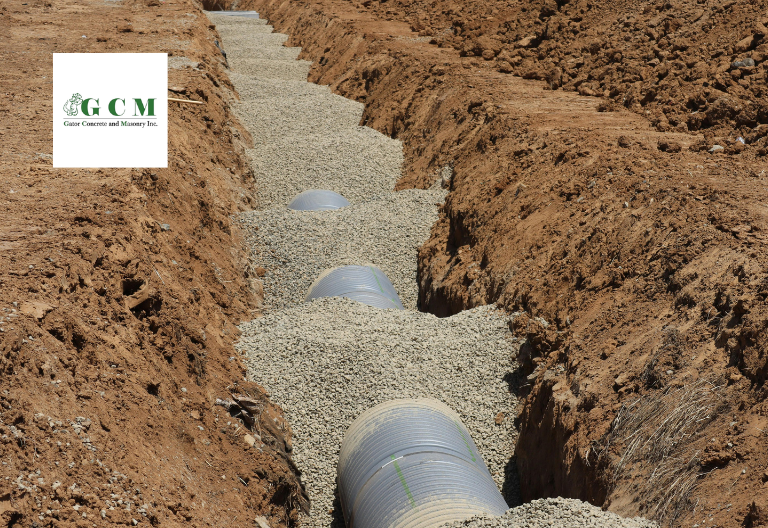
Subsurface systems help remove water below the surface where it cannot be managed through grading alone.
Typical solutions include:
- French drains
- Perforated drain pipes
- Stormwater collection systems
- Underground drainage networks
When installed correctly, these systems quietly protect the property year after year.
Soil Preparation and Compaction
Even the best drainage system cannot compensate for unstable soil.
Proper soil preparation includes:
- Removing unsuitable materials
- Achieving proper compaction
- Building a stable subgrade
- Preventing water from collecting beneath structures
Strong foundations begin below the concrete.
Common Drainage Mistakes That Increase Maintenance Costs
Many drainage failures begin with avoidable mistakes during construction.
Some of the most common include:
- Flat grading that traps water
- Insufficient slope away from buildings
- Undersized drainage systems that cannot handle heavy rainfall
- Ignoring groundwater conditions
- Poor drainage outlet locations
- Little or no erosion control during construction
- Skipping final drainage inspections before project completion
Each of these issues may appear minor initially, yet they often become major maintenance problems over time.
Drainage Considerations for Florida Properties
Florida presents unique drainage challenges that require careful planning.
Heavy seasonal rainfall can overwhelm poorly designed systems within hours. Hurricane events bring even greater volumes of water, testing every part of the drainage system.
Many areas also have high groundwater tables, making underground drainage more challenging.
Sandy soils, common throughout the Tampa region, drain quickly but can also allow water to move beneath structures if grading is not properly designed. That movement may contribute to erosion and foundation instability.
Local municipalities also enforce stormwater management and permitting requirements that must be incorporated into site design before construction begins.
In the Tampa area especially, drainage planning deserves extra attention. Frequent storms, coastal weather, changing groundwater conditions, and demanding building requirements make proper site preparation one of the smartest investments a property owner can make.
Best Practices for Long-Term Property Performance
Long-term success starts before construction ever begins.
Property owners should consider these proven practices:
- Perform detailed site evaluations before construction.
- Design grading and drainage together rather than separately.
- Install quality drainage materials designed for long service life.
- Inspect drainage systems on a regular schedule.
- Keep swales, drains, and catch basins clean and functioning.
- Correct drainage concerns before they affect foundations or concrete.
Routine maintenance today helps prevent major repairs tomorrow.
Why Experienced Site Contractors Make a Difference
Successful drainage systems are rarely the result of one trade working alone.
Experienced site contractors coordinate grading, excavation, drainage installation, foundation preparation, and soil stabilization as one complete process. Every step affects the next.
Reading civil plans accurately allows contractors to identify drainage concerns before equipment arrives on site. Small adjustments made during excavation often prevent significant problems years later.
Just as importantly, experienced contractors understand the difference between building to simply pass inspection and building for long-term performance.
Build on a Strong Foundation with Gator Concrete and Masonry Inc.
A well-built property starts below the surface. Proper grading, drainage planning, excavation, and foundation construction work together to protect your investment for years to come. At Gator Concrete and Masonry Inc., we bring more than 25 years of experience serving Tampa and surrounding Florida communities with dependable site preparation, structural foundations, concrete work, and CMU construction. If you’re planning a new project and want drainage systems designed for lasting performance, contact our team today. We’ll help build a stronger, more durable foundation from the ground up.