
Quick Overview:
Compaction and vibration are often overlooked, but they directly control structural concrete performance. From settlement issues to hidden voids, poor execution leads to long-term damage. This guide breaks down why these steps matter in engineered and coastal construction.
The Most Overlooked Failure Point in Concrete
Most structural failures don’t start on paper. They start in the field. Quietly. Early. And usually, no one notices until it’s too late.
We’ve seen it more times than we’d like to admit. A set of drawings looks solid, engineering checks out, loads are calculated down to the decimal, and yet… cracks show up, slabs settle, columns don’t perform the way they should. Not because the design failed. Because execution did.
Two of the most overlooked steps in that execution? Compaction and vibration.
They’re not flashy. No one takes photos of them for project portfolios. They don’t show up in finished walk-throughs. But they are, without question, two of the most critical processes in structural concrete work.
Compaction deals with the soil, what everything sits on. Vibration deals with the concrete, what everything is built from. Both are invisible once the job is done. And that’s exactly why they get ignored.
Now take that same oversight and place it in a high-stakes build. Coastal homes. Elevated slabs. Engineered foundations. Structures exposed to moisture, wind loads, flood conditions. Suddenly, those “minor steps” become the difference between long-term performance and long-term problems.
This isn’t basic workmanship. This is structural performance. And if you’re building in environments where there’s no margin for error, you can’t afford to treat these as optional.
What “Compaction” Really Means in Structural Work
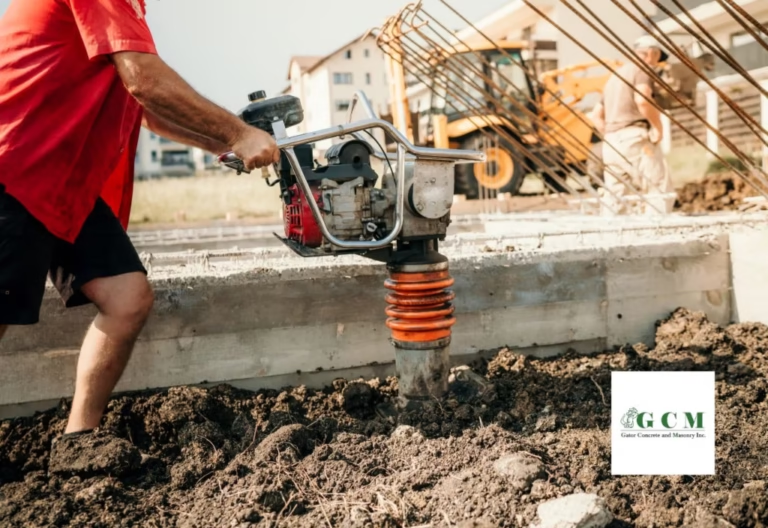
Compaction gets thrown around like it’s a routine checklist item. Run a plate compactor, call it good, move on. That’s not what we’re talking about here.
In structural work, compaction is about preparing a stable, predictable base that can actually support the loads the structure is designed for. It’s tied directly to load-bearing capacity, settlement control, and how the structure behaves over time.
If the soil beneath your foundation isn’t properly compacted, it doesn’t matter how strong your concrete is. The structure will move. And once it moves, everything above it starts reacting.
Proper compaction involves more than just pressing soil down. It’s about:
- Controlling lift thickness
- Achieving target density
- Managing moisture content
- Working with engineered fill, not random backfill
There’s a direct connection between compaction and how the structure performs long term. You can’t separate the two.
We see this play out clearly in systems like:
- Grade beams, where loads are transferred across spans and into bearing points
- Drilled piers, where surrounding soil stability matters just as much as the shaft itself
- Elevated slabs, where differential settlement can create stress points fast
The key point is simple. Poor compaction means movement starts before the concrete even has a chance to do its job. And once that movement begins, you’re no longer dealing with a structural system that behaves the way it was designed.
What “Vibration” Does Inside Concrete (That You Can’t See)
Now let’s talk about what happens after the pour.
There’s a common misconception out there. Concrete is placed, it looks good, it cures, and that’s it. Finished product. But that assumption skips a critical step.
Concrete doesn’t just need to be placed. It needs to be consolidated. That’s where vibration comes in.
Internal vibration does a few essential things:
- Removes trapped air
- Helps the concrete flow around rebar
- Increases density and bond strength
Without proper vibration, you’re left with voids inside the concrete. Areas where the material didn’t fully settle. Spots where reinforcement isn’t properly embedded. Weak zones that don’t show up until the structure is under load.
We’ve opened up pours before and seen it firsthand. Honeycombing around columns. Gaps along beam edges. Rebar that should be fully encased, partially exposed instead.
And here’s the thing. The concrete might still pass a basic strength test. On paper, it meets spec. But in place? It’s a different story.
Concrete strength on paper is one thing. Concrete strength in place is what actually matters.
Vibration isn’t about making the surface look nice. It’s about making sure the internal structure of the concrete matches the design intent. Without it, you’re guessing.
The Hidden Risks of Getting It Wrong
Differential Settlement
When compaction isn’t uniform, the structure doesn’t settle evenly. Some areas hold. Others shift. That creates internal stress.
You start seeing cracks in slabs. Beams begin to carry loads they weren’t intended to. Walls show signs of movement. And once that differential settlement begins, it’s not something you can easily correct.
It’s not just cosmetic. It’s structural.
Honeycombing and Voids
Poor vibration leads to incomplete consolidation. That’s where honeycombing shows up. Exposed aggregate. Cavities in the concrete. Weak zones right where you need strength the most.
Around rebar, this becomes even more critical. If the concrete doesn’t fully surround the steel, you lose bond strength. And that affects load transfer directly.
It’s one of those issues that hides until it becomes a problem.
Reduced Structural Capacity
When concrete isn’t properly consolidated, it doesn’t perform to its design capacity. It might meet ACI expectations in testing, but field conditions tell a different story.
Load paths get compromised. Stress isn’t distributed evenly. Over time, that leads to performance issues that trace back to one thing. Execution.
Long-Term Coastal Risks
In coastal environments, the stakes go even higher.
Voids and poor consolidation allow moisture to enter. Once water reaches the reinforcement, corrosion begins. And in salt-heavy environments, that process accelerates.
Now you’re dealing with:
- Rust expansion
- Cracking from internal pressure
- Loss of structural integrity over time
In flood zones and V-zones, where structures are already exposed to harsh conditions, these issues don’t take long to show up.
Why This Matters More in Coastal and Engineered Builds
Not every project carries the same level of risk. But when you’re working in coastal environments or on engineered systems, there’s no room for shortcuts.
We’re talking about:
- V-zone construction
- FEMA freeboard requirements
- Elevated structural systems designed to resist flood forces
These builds deal with higher loads. More exposure. Stricter code requirements. And they rely heavily on the assumption that the structure was executed exactly as designed.
Compaction and vibration play a direct role in that.
In these environments:
- Soil instability can lead to rapid failure
- Moisture exposure amplifies small defects
- Structural elements must perform under dynamic conditions
There’s no buffer. No margin for “close enough.”
In these builds, execution is part of the engineering.
Where Compaction and Vibration Show Up in Real Projects
These processes aren’t isolated. They show up everywhere in structural work.
You see compaction in:
- Subgrades for grade beams and pile caps
- Backfill around drilled shafts
- Base prep for structural slabs
You see vibration in:
- CIP columns and beams
- Structural slabs, including post-tension systems
- Deep foundation elements where access is limited
Every one of these components relies on proper execution.
And when you’re working off detailed plans, foundation layouts, structural systems, multi-level load transfers, everything is connected. One weak point affects the whole system.
That’s why coordination matters. Not just between trades, but between field crews and structural engineers.
The Gap Between “Standard Practice” and “Engineered Execution”
Here’s where things really separate.
Most crews know the basics. They compact. They vibrate. But how they do it varies a lot.
Engineered execution means:
- Controlling lift thickness, not guessing
- Conditioning moisture before compaction
- Using vibration correctly, spacing, depth, duration
Too much vibration can cause segregation. Too little leaves voids. It’s not just about doing it. It’s about doing it right.
We’ve worked on projects where this level of detail made all the difference. Where coordination with the structural engineer wasn’t optional, it was necessary.
That’s the gap. Between doing the work and understanding the work.
What GCs and Architects Should Actually Look For
If you’re overseeing a project, here’s what matters:
- Is compaction being tested and documented?
- Are lifts controlled and verified?
- Is moisture content being managed?
- Is vibration consistent across pours?
- Are crews trained on structural requirements, not just general practice?
- Is there real coordination with the structural plans?
If the answer to any of those is unclear, that’s a risk.
Why This Is Not a Commodity Scope
There’s a mindset out there. Concrete is concrete. Lowest bid wins. Move on.
That approach works, until it doesn’t.
Because structural concrete isn’t a commodity. It’s a system. And execution directly affects how that system performs.
Skilled crews understand that. They know what’s at stake. They don’t cut corners because they’ve seen what happens when you do.
At Gator Concrete and Masonry Inc, that’s exactly how we approach it. We’re not competing on basic residential work. We focus on engineered systems, structural performance, and getting it right the first time.
Structure Starts Before the Concrete Sets
If there’s one takeaway here, it’s this.
Structural performance doesn’t begin when the concrete cures. It begins before the pour. In the soil. In the process. In the details most people don’t see.
Compaction and vibration aren’t just steps in the process. They are structural controls.
Ignore them, and the structure pays the price.
If you’re working on a project that involves engineered foundations, coastal exposure, or structural concrete systems, don’t leave execution to chance.
Contact Gator Concrete and Masonry Inc today! We specialize in technical structural concrete and masonry. From grade beams to elevated systems, we build with precision, coordination, and long-term performance in mind.